7 Signs Your Septic Tank Is Full or Failing
The clearest signs a septic tank is full or failing are slow drains throughout the house, gurgling pipes, sewage odors indoors or outside, soggy or unusually green grass over the drainfield, sewage backing up into drains, and standing water near the tank. Any one of these means you should call a septic pro and likely get the tank pumped.
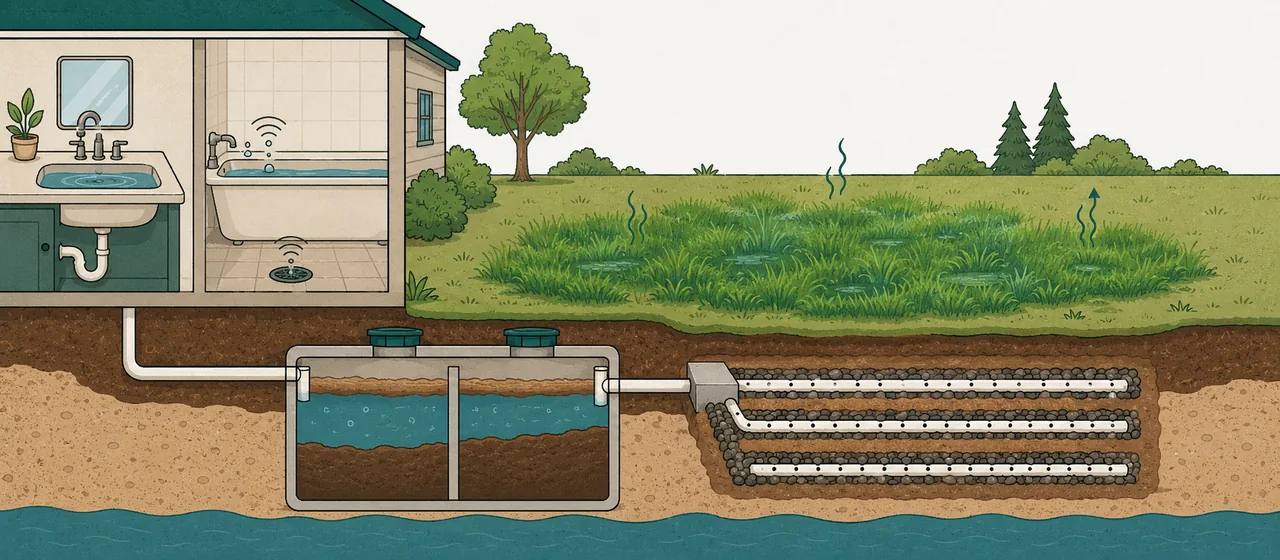
- Slow drains, gurgling, and sewage smells are the earliest warning signs — don't wait for a backup.
- A full tank and a failing system are different problems: pumping fixes a full tank but won't fix a damaged drainfield.
- Soggy or bright-green grass over the drainfield often means solids have clogged the soil — the most expensive failure to fix.
- Sewage backing up into the house is an emergency; stop using water and call a pro.
- Pumping every 3–5 years prevents most of these problems and costs far less than a drainfield replacement.
Full vs. failing: know the difference
These two get lumped together, but they're not the same problem. A full tank means solids and scum have built up to the point where wastewater no longer has room to separate properly — the fix is a routine pump-out. A failing system means something is actually broken: a clogged or saturated drainfield, a cracked tank, a collapsed pipe, or a dead pump in an aerobic unit. Pumping won't fix that.
The tricky part is that the symptoms overlap. Slow drains and odors show up in both cases. That's why a single pump-out that doesn't solve the problem is itself a diagnostic clue — if trouble comes back within weeks, you're probably dealing with a failing drainfield, not just a full tank. When in doubt, get it inspected. More than 1 in 5 U.S. households rely on a septic system, and most failures trace back to skipped maintenance, not bad luck.
The 7 signs to watch for
Here are the warning signs, roughly in the order they tend to appear — from subtle to can't-ignore-it.
- Slow drains everywhere at once. One slow sink is a clog. Every drain in the house draining sluggishly points to the tank, not the plumbing.
- Gurgling pipes. A bubbling or gurgling sound from toilets and drains means air is trapped because the tank or line is too full to let water flow freely.
- Sewage odors. A rotten-egg or sewage smell indoors, near floor drains, or out in the yard means gases that should be venting through the system are escaping somewhere they shouldn't.
- Soggy ground or lush green grass over the drainfield. Grass that's noticeably greener, taller, or wetter than the rest of the lawn means effluent is surfacing instead of soaking in. This is a classic sign of a saturated or clogged drainfield.
- Standing water or pooling near the tank or drainfield. Liquid pooling above the system — especially in dry weather — means it can't absorb what's coming in.
- Sewage backing up into the house. Wastewater coming up through the lowest drains (often a basement floor drain or first-floor toilet) is the most serious sign. Stop running water and call a pro immediately.
- Drains that are slow again right after a pump-out. If you just had the tank pumped and problems return fast, the tank isn't the issue — the drainfield likely is.
What's actually happening inside the tank
A septic tank works by letting gravity do the sorting. Solids sink to the bottom as sludge, grease and lighter material float to the top as scum, and the relatively clear liquid in the middle flows out to the drainfield to be filtered through the soil. (If you want the full mechanics, see our plain-English guide on how a septic system works.)
Problems start when the sludge and scum layers grow too thick. Wastewater no longer has room to settle, so solids get pushed out toward the drainfield — where they're never supposed to go. Once solids clog the soil's pores, the drainfield can't absorb liquid anymore, and you get backups, surfacing effluent, and the soggy lawn. That's why a $300–$600 pump-out on schedule is the single best thing you can do: it keeps solids out of the drainfield, which is the part that costs $3,000 to $15,000 or more to replace.
What to do when you spot a sign
Don't panic, but don't sit on it either. Here's the practical order of operations.
- Ease up on water use. The less wastewater you send in, the more time you buy before a backup. Hold off on laundry, long showers, and dishwasher runs.
- Check your records. If it's been 3–5 years (or more) since the last pump, a full tank is the likely culprit. See how often you should pump a septic tank for the schedule that fits your household.
- Call a licensed septic professional. They'll measure the sludge and scum levels and tell you whether you need a pump, a repair, or a fuller inspection. You can compare typical pricing on our septic pumping cost page.
- Don't reach for chemical 'septic treatments' as a fix. Additives won't unclog a drainfield or fix a mechanical failure, and some can make things worse.
- If sewage is backing up indoors, treat it as an emergency. Stop using water entirely and get a pro out the same day.
Catching problems before they start
The cheapest septic problem is the one you prevent. The EPA recommends having your system inspected at least every three years and pumping the tank every three to five years, adjusted for tank size and household size. Following that one habit prevents the large majority of the failures above.
A few other moves go a long way: spread out heavy water use, keep grease and 'flushable' wipes out of the system, don't park or build over the drainfield, and keep a simple log of pump-outs and inspections. Our septic do's and don'ts checklist covers the full list. And if you're buying or selling a home with a septic system, get a dedicated septic inspection — a tank that looks fine on the surface can hide a failing drainfield underneath.
Frequently asked questions
How do I know if my septic tank is full or if something is broken?
If a single pump-out solves the slow drains and odors, the tank was simply full. If the same symptoms come back within days or weeks of pumping, the problem is almost certainly a failing drainfield or a mechanical issue — not a full tank. A septic professional can confirm by measuring sludge levels and inspecting the drainfield.
Will pumping my septic tank fix a soggy yard or backups?
Only if the cause is a full tank. Pumping removes accumulated solids and restores capacity, which clears most slow-drain and backup problems. But if solids have already clogged the drainfield soil, pumping gives temporary relief at best — the drainfield itself needs repair or replacement.
How long can I wait after noticing a warning sign?
Slow drains and faint odors can sometimes wait a few days for a scheduled appointment, but you should reduce water use in the meantime. Sewage backing up into the house is an emergency — stop using water and call a pro the same day to avoid a bigger mess and possible health hazard.
Why is the grass over my drainfield greener than the rest of the lawn?
Because partially treated effluent is surfacing and feeding the grass like fertilizer instead of soaking into the soil. It usually means the drainfield is saturated or clogged. It's one of the more reliable early signs of drainfield trouble and worth an inspection.
How much does it cost to fix a full or failing septic tank?
A routine pump-out for a full tank typically runs $300–$600 nationally. A failing drainfield is far costlier — usually $3,000 to $15,000 or more to replace — which is exactly why staying on a 3-to-5-year pumping schedule pays for itself.
Keep reading
How Often Should You Pump a Septic Tank?
Most households should pump their septic tank every 3 to 5 years, and the EPA recommends a professional inspection at least every …
What Happens If You Never Pump Your Septic Tank?
If you never pump your septic tank, sludge keeps building until solids overflow into the drainfield, clogging the soil with a "bio…
Drainfield Failure: Causes, Signs, and How to Protect Yours
A septic drainfield fails when the soil can no longer absorb wastewater, usually from a clogged "biomat" layer built up by skipped…