What Happens If You Never Pump Your Septic Tank?
If you never pump your septic tank, sludge keeps building until solids overflow into the drainfield, clogging the soil with a "biomat" that water can no longer pass through. The result is sewage backing up into your home or surfacing in the yard, and eventually total drainfield failure — a repair that costs $10,000 to $25,000 or more instead of a few hundred dollars for pumping.
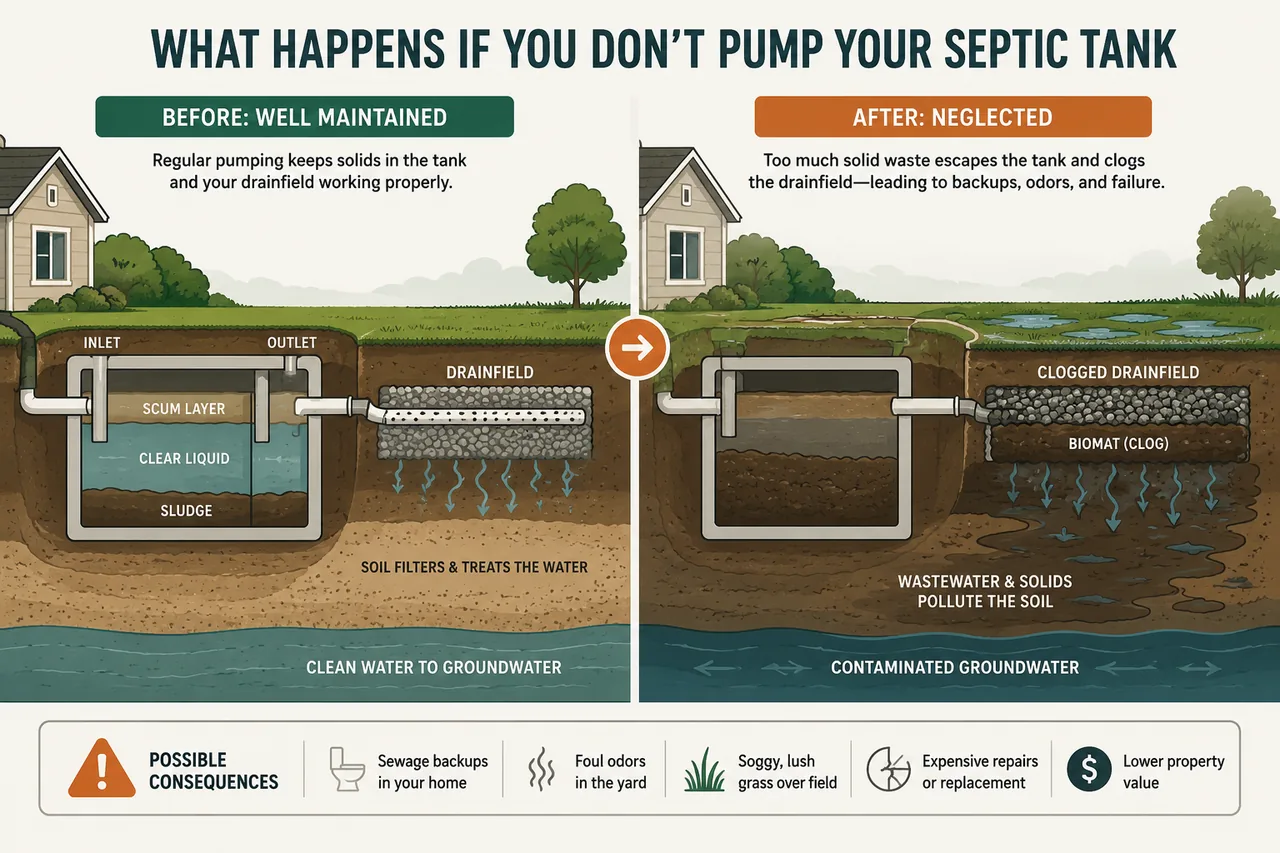
- A septic tank works by letting solids settle and pumping removes that sludge — skip it and the sludge has nowhere to go but into your drainfield.
- Once solids reach the drainfield, they clog the soil permanently. That's the failure that costs real money.
- The damage moves in stages: slow drains and odors first, then backups, then a dead drainfield.
- Pumping costs a few hundred dollars; a failed drainfield or full system replacement runs $10,000–$25,000+.
- The EPA recommends pumping every 3–5 years and inspecting every 1–3 years. Neglect is the leading preventable cause of failure.
Why pumping matters in the first place
A septic tank doesn't treat waste so much as separate it. Wastewater flows in, heavy solids sink to the bottom as sludge, grease and lighter material float on top as scum, and the relatively clear liquid in the middle flows out to the drainfield (also called the leach field) to soak into the soil.
The catch: solids don't disappear. Bacteria break down some of the sludge, but the rest just accumulates, layer on layer, year after year. Pumping is how you physically remove that buildup. It's the one maintenance task the whole system depends on. Skip it long enough and the tank simply runs out of room for solids to settle.
For the full mechanics, see our plain-English guide on how a septic system works.
What actually happens, stage by stage
Never pumping isn't a single event — it's a slow slide that gets more expensive at every step. Here's the progression most pros see:
- Stage 1 — The tank fills with sludge. The settling zone shrinks. Wastewater now moves through the tank too fast for solids to drop out.
- Stage 2 — Solids escape to the drainfield. With nowhere to settle, sludge and scum get pushed out the outlet pipe and into the leach field — exactly where they were never supposed to go.
- Stage 3 — The drainfield clogs. Those solids feed a thick, greasy layer of bacteria called biomat that seals the soil. A thin biomat is normal and even helps filter waste; an overloaded one turns waterproof and stops the soil from absorbing anything.
- Stage 4 — Backups and surfacing. With the soil sealed off, wastewater has nowhere to go. It backs up into the lowest drains in your house or bubbles up as soggy, smelly patches over the drainfield.
- Stage 5 — Total drainfield failure. Once the soil is clogged with biomat, it's often dead for good. Pumping at this point won't fix it — you're into repair or replacement.
The point of no return: the drainfield
Here's the part most homeowners don't realize until it's too late. A full tank is a minor problem — you pump it and move on. A clogged drainfield is a major one, because soil doesn't un-clog itself on any useful timeline.
When biomat seals the soil, the field can no longer accept water. The damage is frequently irreversible: the soil's pores are choked off and the field has to be rested for months or rebuilt entirely. That's why the cheap, boring habit of pumping every few years matters so much — it keeps solids in the tank, where they're easy to remove, and out of the drainfield, where they're catastrophic.
If your system is already showing symptoms, our guide on drainfield failure walks through causes, signs, and how to protect what you have left.
Signs you've waited too long
The system usually warns you before it fails outright. Catching it at this point can be the difference between a pump-out and a replacement. Watch for these:
For a fuller rundown, see our guide on the 7 signs your septic tank is full or failing. If you're noticing any of these, stop adding water to the system and call a pro before it escalates.
- Drains and toilets that gurgle or empty slowly throughout the house
- Sewage odors indoors, near the tank, or over the drainfield
- Wastewater or dark, sludgy water backing up into tubs, sinks, or floor drains
- Bright green, spongy grass or standing water over the leach field, even in dry weather
- Slow recovery — fixtures that drain fine, then back up again after laundry or a few showers
What it costs to ignore it
This is the math that makes the case on its own. Pumping a typical tank costs a few hundred dollars and takes about an hour. Letting it go costs an order of magnitude more:
Over 30 years, faithful pumping might total $3,000–$6,000. A single drainfield failure can match or beat that in one bill. And that's before the side costs: a failing system can contaminate your own well and a neighbor's, fail a home inspection when you sell, and trigger health-department orders to fix it on a deadline.
- Routine pumping: roughly $300–$600 in most areas — see our septic pumping cost breakdown for local ranges
- Drainfield replacement: about $5,000–$20,000 depending on size and soil
- Full system replacement (tank + drainfield): roughly $10,000–$25,000, and more with permits and difficult sites
- Engineered systems (mound, aerobic, sand filter): $15,000–$30,000+ when poor soil rules out a standard field
The other costs: health, environment, and resale
A neglected system doesn't just hit your wallet. Raw sewage that surfaces or leaches out untreated carries bacteria, viruses, and nitrates that can foul groundwater, nearby wells, streams, and lakes. The EPA flags failing septic systems as a real source of waterborne illness and well contamination.
There's a resale angle too. Septic problems are one of the most common deal-killers in rural and exurban home sales — a failed field discovered during a septic inspection when buying or selling a home can knock five figures off a price or sink the deal. And don't assume you're covered: homeowners insurance usually won't pay for damage from neglect or normal wear, so a skipped-maintenance failure typically comes straight out of pocket.
How to never end up here
Avoiding all of the above is genuinely simple and cheap. A few habits cover most of it:
If you're weighing whether a septic system is even worth the upkeep versus connecting to a main, our septic vs. sewer comparison lays out the trade-offs, and our aerobic vs. conventional septic guide covers system types and their maintenance demands.
- Pump on schedule. The EPA recommends every 3–5 years for a typical household; heavy use or a smaller tank means more often — see how often you should pump a septic tank.
- Inspect every 1–3 years so a pro can measure sludge depth and catch problems early.
- Watch your water use. Overloading the system with water pushes solids toward the field faster.
- Keep the wrong stuff out — grease, wipes, and harsh chemicals. Our septic do's and don'ts checklist covers the rest.
- Protect the drainfield: no parking, paving, or planting trees over it.
Frequently asked questions
How long can you go without pumping a septic tank?
Most households can go 3–5 years between pumpings, per EPA guidance. Some smaller tanks or larger families need it every 1–2 years. There's no fixed limit before damage — it depends on tank size, household size, and water use — but every extra year of neglect raises the odds that solids reach and clog the drainfield.
Can a septic tank fix itself if I just stop using water?
No. Resting the system can buy time and reduce backups, but it won't reverse sludge buildup in the tank or a biomat-clogged drainfield. The accumulated solids have to be physically pumped out, and a clogged field usually needs to be rested for months or rebuilt — it doesn't recover on its own.
What's the first sign a tank is overdue for pumping?
Usually slow drains and gurgling throughout the house, sometimes with a faint sewage odor near the tank or drainfield. Those are early warnings that the tank is full and solids are starting to move toward the field. Backups and soggy ground over the drainfield are later, more serious signs.
Is it cheaper to pump regularly or just replace the system when it fails?
Far cheaper to pump. Routine pumping runs a few hundred dollars; a failed drainfield costs $5,000–$20,000 and a full system replacement $10,000–$25,000 or more. Thirty years of pumping rarely matches the cost of a single replacement caused by neglect.
Will homeowners insurance cover a septic failure from not pumping?
Typically no. Standard homeowners policies exclude damage from neglect, lack of maintenance, and normal wear and tear — which is exactly what a never-pumped tank failure is. Sudden, accidental damage may be covered, but a slow maintenance-driven failure usually isn't.
Keep reading
How Often Should You Pump a Septic Tank?
Most households should pump their septic tank every 3 to 5 years, and the EPA recommends a professional inspection at least every …
7 Signs Your Septic Tank Is Full or Failing
The clearest signs a septic tank is full or failing are slow drains throughout the house, gurgling pipes, sewage odors indoors or …
Drainfield Failure: Causes, Signs, and How to Protect Yours
A septic drainfield fails when the soil can no longer absorb wastewater, usually from a clogged "biomat" layer built up by skipped…