How to Find Your Septic Tank, and Why Risers Pay Off
Your septic tank is usually buried 10 to 25 feet from the house, on the side where the main sewer line exits. The fastest way to find it: pull the as-built diagram from your county health department. No record? Locate the 4-inch sewer pipe in your basement, walk that direction outside, and probe the soil with a metal rod every couple of feet until you hit the tank.
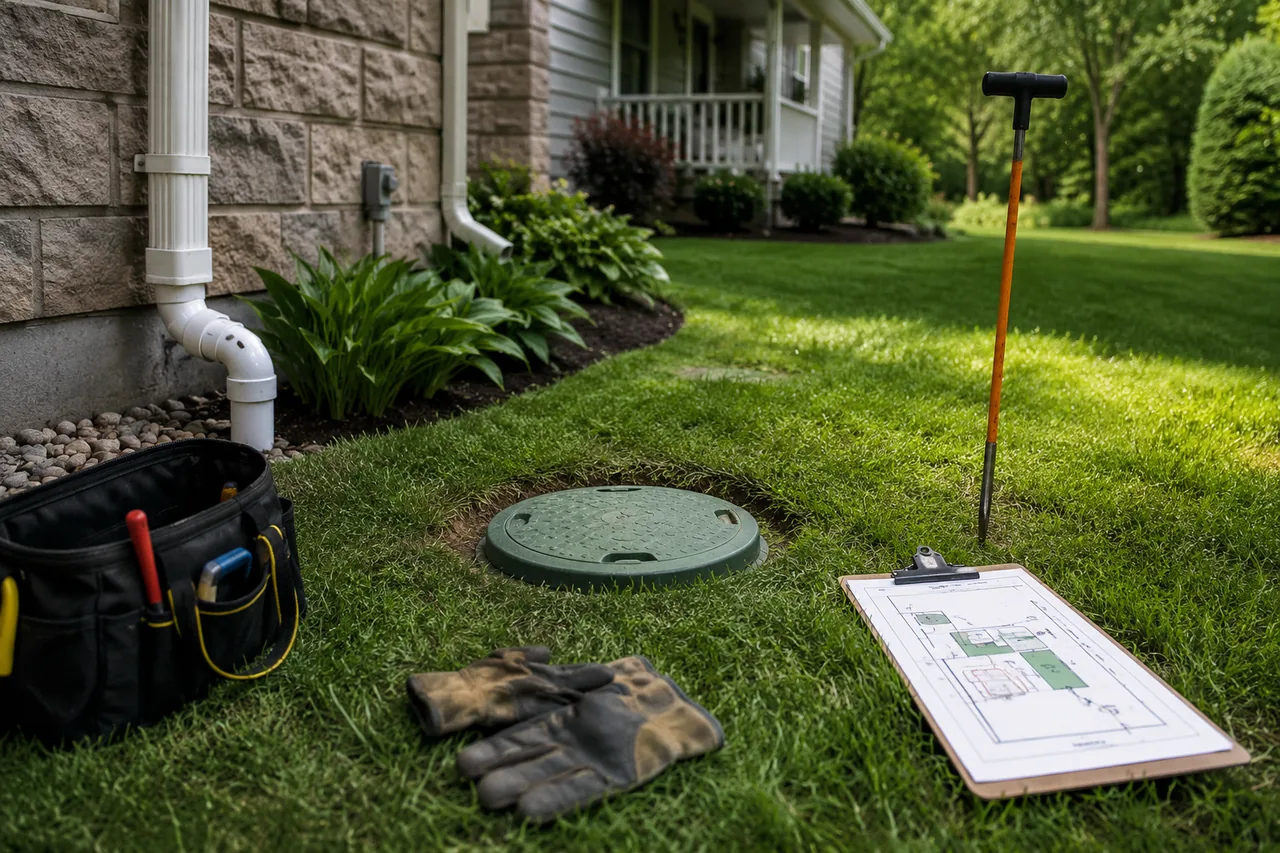
- Start with paperwork: the as-built diagram on file with your county health department shows the exact tank location in about five minutes.
- No record? Find the 4-inch sewer pipe where it leaves the house, follow that line outside, and probe the soil with a metal rod until you hit the tank lid (usually 10-25 feet out).
- Tanks sit 6 to 24 inches below grade. A magnetic locator finds the rebar or metal handles in concrete tanks; it won't help on plastic or fiberglass.
- Risers bring the access lid to ground level, killing the $50-$200 dig fee charged on every pump-out, inspection, and repair.
- A pro riser install runs about $300-$500 per lid and typically pays for itself in two to three service visits.
Where septic tanks are usually buried
Before you start digging, it helps to know where to look. Septic tanks follow predictable rules because they have to work with gravity. Waste flows out of the house through a single main drain, and the tank sits downhill from that exit so everything drains by gravity at roughly a quarter-inch-per-foot slope.
That means your tank is almost always on the side of the house where the main bathroom or kitchen plumbing stacks up, in line with where the sewer pipe leaves the foundation. Most tanks sit 10 to 25 feet from the house, with the lid buried anywhere from 6 inches to 2 feet below the surface.
- Look on the side of the home where the sewer line exits the foundation
- Expect the tank 10 to 25 feet out from the wall
- The lid is typically 6 to 24 inches below grade
- Watch for clues: a rectangular patch of grass that's greener, browner, or grows differently; a low or high spot; or an area that thaws first after snow
Method 1: Pull the records (do this first)
The single fastest and most reliable way to find your tank is the as-built diagram. This is a drawing filed with your local health department when the system was installed, showing the exact location, dimensions, and layout of the tank, distribution box, and drainfield as actually built on the property. It often gives you measurements off the house corner, so you can walk straight to the spot in about five minutes.
County health departments keep these records public, and many maintain septic maps you can request by phone, email, or an online portal. If you bought the home recently, also check your closing documents and any septic inspection report from the sale. If the inspection came up during your purchase, our guide on a septic inspection when buying or selling a home covers what that paperwork should include.
- Call or search your county/parish health department's environmental health office
- Ask for the as-built or septic permit on file for your address
- Check your home purchase paperwork and prior inspection reports
- Ask the previous owner or neighbors with the same builder
Method 2: Follow the 4-inch sewer pipe
No records on file? Go to where the plumbing leaves the building. In a basement or crawl space, find the 4-inch sewer pipe (the big one, larger than your water and vent lines) where it passes through the foundation wall. Note its direction and roughly how high it exits.
Now go outside and walk in that same direction. The tank is in a straight line out from that exit point, usually 10 to 25 feet away. The pipe runs downhill at about a quarter-inch per foot, so the tank inlet is buried a bit deeper than the exit point. Pace it off and mark your search zone before you start probing.
Method 3: Probe the soil
Once you've narrowed the search zone, a soil probe is the cheapest tool that actually works. It's a thin metal rod, typically 3 to 4 feet long, that you push straight down into the ground. You're feeling for the hard, flat top of the tank versus the give of plain soil.
Start where the sewer line should be and probe every couple of feet along that line, working outward from the house. When the rod hits a solid surface at a consistent depth across a rectangular area roughly 5 by 8 feet, that's your tank. Probe gently and at a slight angle so you don't crack a thin plastic lid or punch into a pipe.
- Use a 3-to-4-foot insertion rod or a length of rebar with a handle
- Probe every ~2 feet along the path of the sewer line
- Solid contact across a 5-by-8-foot rectangle marks the tank
- Once located, dig down to confirm the lid before any service is scheduled
Method 4: Use a metal detector or locator
A metal detector (or better, a magnetic locator) can speed things up on concrete tanks, which are reinforced with steel rebar and often have iron lid handles. Sweep the suspected area and watch for a strong, consistent signal in a rectangular pattern.
The catch: this only works on tanks with metal in them. Plastic and fiberglass tanks won't trip a detector at all, so if you get nothing, don't assume there's no tank. Fall back to probing. A licensed septic pro can also push a transmitter through the line or run a camera to pinpoint the tank without guesswork.
Why risers pay off once you've found it
Here's the part most homeowners wish they'd known sooner. If your tank lid is buried, every single service visit starts with digging it up. That's 6 to 24 inches of soil to move by hand, or an extra dig charge from the pumper, typically $50 to $200 added to each visit. Over a system's 20-to-30-year life, with pumping every 3 to 5 years plus inspections, that buried lid can quietly cost you $300 to $1,500 in dig fees alone.
A riser fixes this permanently. It's a short plastic or concrete pipe that extends from the tank's access port up to ground level (or just above it), capped with a removable lid. Once it's in, the pump truck operator pops the lid and goes to work. A pump-out that took an hour with shoveling takes about 15 minutes. No more guessing where the tank is, no pick-axe scars in your lawn, and inspectors get fast, repeatable access.
On cost: a professional riser install typically runs about $300 to $500 per access point, all parts and labor included. Most tanks have two ports (one over the inlet, one over the outlet), so budget accordingly if you want full access. DIY parts run roughly $70 to $200 if you're handy. Either way, a riser usually pays for itself in two to three service visits, and the riser materials outlast the tank: HDPE about 25 years, fiberglass about 30, concrete about 40.
The smartest time to add one is during a scheduled pump-out, when the tank is already exposed and many companies offer a discount. So once you've found your tank, the next move is easy: book the service, see what it costs in your area, and have risers installed while the hole is open. If you're not sure how often that should happen, see how often to pump your septic tank and the warning signs your tank is full.
- Buried lid = $50-$200 dig fee on every pump, inspection, and repair
- Lifetime dig cost can hit $300-$1,500 over 20-30 years
- Pro riser install: ~$300-$500 per access point
- Best value: add risers during a scheduled pumping while the tank is open
Frequently asked questions
How deep is a septic tank buried?
The top of the tank and its access lid usually sit 6 inches to 2 feet below the surface. The tank body itself extends several feet deeper. If your lid is more than a foot down, a riser is well worth it to avoid digging on every service visit.
How far is the septic tank from the house?
Most tanks sit 10 to 25 feet from the foundation, on the side where the main 4-inch sewer pipe exits the building. Code minimums are often around 5 to 10 feet from the foundation, but the actual distance varies by lot and installer. Your as-built diagram has the exact figure.
Can I find my septic tank with a metal detector?
Sometimes. A metal detector or magnetic locator picks up the steel rebar in a concrete tank and iron lid handles, so it works well on concrete systems. It won't detect plastic or fiberglass tanks, which have no metal. If you get no signal, switch to probing the soil with a rod.
Do I really need risers, or are they just an upsell?
They're genuinely useful if your lid is buried more than a few inches down. Every pump-out, inspection, and repair otherwise starts with digging, which adds $50 to $200 per visit. A riser pays for itself in two or three visits and makes future service faster and cheaper. If your lid is already at grade, you don't need one.
What does it cost to install a septic riser?
A professional install typically runs about $300 to $500 per access point, parts and labor included. DIY parts cost roughly $70 to $200. Many tanks have two access ports, so full coverage may mean two risers. Adding them during a scheduled pumping is the cheapest option since the tank is already exposed.
Who can locate my septic tank for me?
A licensed septic pumping or inspection company can find it quickly using line transmitters, cameras, and probes, often as part of a regular service call. Starting with the county health department's as-built record is free and still the fastest first step.
Keep reading
How Often Should You Pump a Septic Tank?
Most households should pump their septic tank every 3 to 5 years, and the EPA recommends a professional inspection at least every …
7 Signs Your Septic Tank Is Full or Failing
The clearest signs a septic tank is full or failing are slow drains throughout the house, gurgling pipes, sewage odors indoors or …
Septic Inspections When Buying or Selling a Home
If a home has a septic system, get it inspected before you close. A real estate septic inspection typically costs $300–$650, inclu…